A great ad script boils down to four essential parts: a hook to grab attention, a problem the audience deeply relates to, your product as the undeniable solution, and a crystal-clear call-to-action.
Think of it as a mini-story. In this quick tale, your viewer is the main character, and your product is the hero that swoops in to save the day.
The Anatomy of a Modern Ad Script
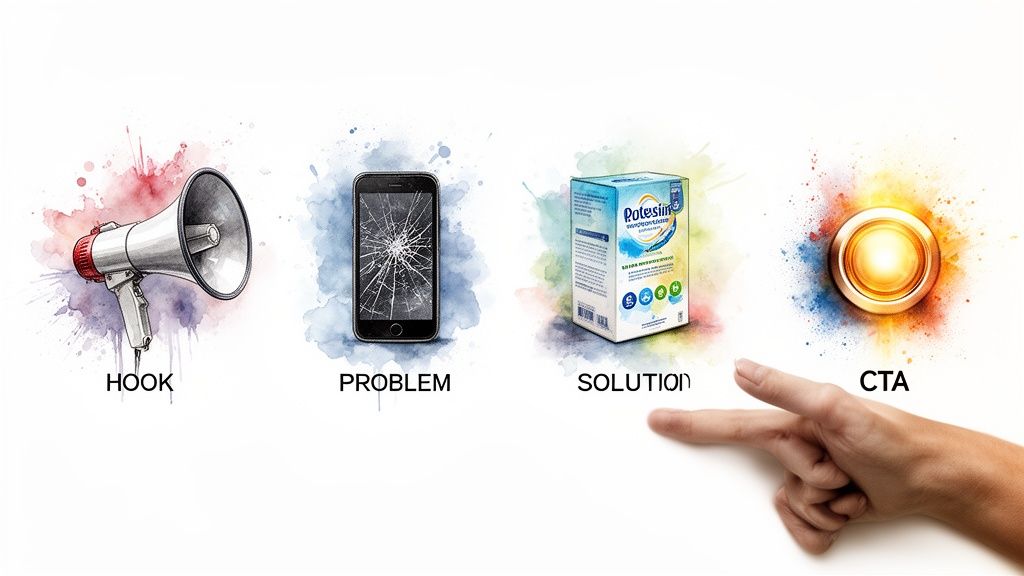
Before we get into the nitty-gritty of writing, you have to nail the foundational structure of a high-performing ad script. While formulas can sometimes feel a bit restrictive, this four-part anatomy—Hook, Problem, Solution, CTA—is a time-tested framework. It’s designed to guide viewers on a psychological journey, moving them from simple curiosity to actual conversion.
This isn't about being robotic. It's about understanding the narrative flow that captures and holds human attention, which is more critical than ever.
The market is shifting at a breakneck pace. By 2025, digital advertising is projected to gobble up 75% of the total global ad spend, hitting an eye-watering $798.7 billion. The real growth engines? Online video and social media, which just underscores how urgently you need scripts that actually work.
The Four Core Components
Let's pull back the curtain on each element and see what makes it tick. Every part serves a distinct purpose, building on the one before it to create a message that’s both seamless and incredibly persuasive.
To make this crystal clear, here’s a quick breakdown of how these pieces fit together, especially in the context of a fast-paced, 30-second social media ad.
The Core Components of a Winning Ad Script
As you can see, every second counts. Each stage has a specific job to do in a very short amount of time.
-
The Hook (Seconds 0-3): This is it. Your first, and really your only, chance to stop the scroll. It has to be immediate, intriguing, and instantly relevant to your ideal customer. A weak hook means the rest of your script, no matter how brilliant, might as well not exist.
-
The Problem (Seconds 4-10): Once you've got their attention, you need to make them feel seen. This is where you introduce a pain point or challenge they know all too well. When you articulate their problem clearly, you build an instant connection and establish a genuine need for a solution.
-
The Solution (Seconds 11-25): Cue the hero music. Your product or service enters the scene. You're not just listing features; you're demonstrating how it directly solves the problem you just laid out. The focus here is on the transformation and the tangible benefits.
-
The Call-to-Action (Seconds 26-30): The grand finale. You must tell the viewer exactly what you want them to do next. A powerful CTA is direct, simple, and often creates a sense of urgency or presents an offer that's too good to pass up. Without it, even the most captivated viewer is likely to just keep scrolling.
Grasping these foundational elements is absolutely crucial. This knowledge becomes a superpower when you’re dealing with visual media, where crafting effective product video ad scripts demands a perfect blend of this narrative structure with compelling visuals and razor-sharp timing.
A great script isn’t just about what you say; it’s about the emotional journey you guide your audience through in under 30 seconds. Each component—hook, problem, solution, CTA—is a stepping stone on that path.
Crafting a Hook That Stops the Scroll
On social media, the entire battle for attention is won or lost in under three seconds. That’s it. If the first few frames of your video don't slam the brakes on someone's mindless scrolling, the rest of your brilliant script is just dead air. Your opening moment is everything.
A truly great hook does more than just get a glance; it creates an "attention debt." It makes an unspoken promise of value, a hint of intrigue, or a flash of entertainment that people feel compelled to stick around for. This is your one shot to connect with a viewer's core problems or desires.
Types of Hooks That Actually Work
Let's be honest, the old, tired openings like "Are you tired of..." just don't work anymore. Today's audiences have seen it all, and they can smell a generic ad a mile away. Your hook needs to be sharp, specific, and frankly, a little unexpected.
Here are three approaches I’ve seen work time and time again:
- The Provocative Question: Don't ask a simple yes/no question. Instead, ask something that challenges a common belief or makes the viewer completely rethink a problem. Forget "Want whiter teeth?" Try this instead: "What if your morning coffee could actually whiten your teeth?" See the difference?
- The Shocking Statistic: Nothing grabs attention like a surprising number. It establishes instant authority and makes people lean in. A skincare brand could hit them with, "Your phone screen has 10x more bacteria than a toilet seat. Here’s how to protect your skin."
- Start in the Middle of the Action: It’s a classic storytelling trick called in medias res, and it works because it drops the viewer right into the most interesting part of the story. Show the amazing result first—the perfectly organized closet, the beautifully decorated cake—and then rewind to show how you got there.
The single most important job of your hook is to create a knowledge gap. Present a problem, a surprising fact, or a question that your viewer suddenly needs the answer to.
Getting this initial grab right is a cornerstone of any effective short-form video marketing strategy. It sets the tone for everything that follows.
Aligning the Hook with Your Audience
The best hooks aren't just clever for the sake of being clever; they are deeply empathetic. They prove to the viewer, in a split second, that you get them and their world. A hook for a busy working mom will—and should—be totally different from one targeting a Gen Z gamer.
Let's imagine you're selling meal-prep containers. The hook shouldn't even be about the containers. It should be about the chaos they solve.
- Weak Hook: "Our new containers make meal prep easy." (Yawn.)
- Strong Hook: A quick, frantic shot of a refrigerator door being slammed shut as food tumbles out, with the caption: "Stop playing Tetris with your leftovers."
The second one works because it's visual, instantly relatable, and connects with a familiar, frustrating moment. It perfectly sets up the problem your product is about to solve. This is how you turn a generic script into a real, high-converting asset—by understanding your audience's daily struggles and speaking directly to them.
Building a Compelling Narrative
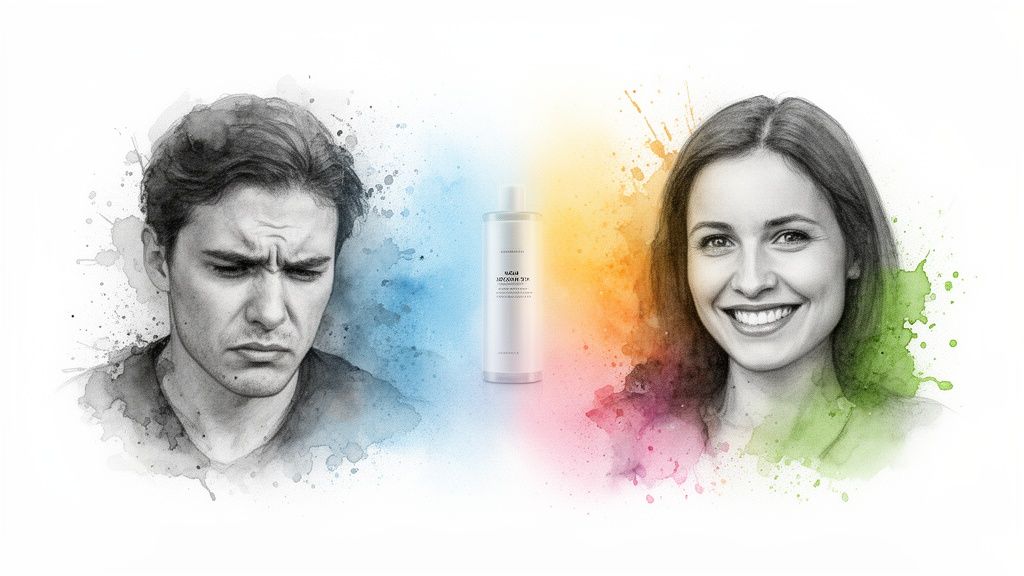
Okay, you’ve landed a powerful hook and stopped the scroll. Now the real work begins. Your next job is to forge a connection that turns that flicker of curiosity into genuine interest. This is the moment your script for advertising has to become more than just an attention-grabber—it needs to tell a story.
The goal is to walk the viewer from a problem they know all too well to a solution they suddenly can’t imagine living without. It’s a delicate balance of empathy and persuasion, and it’s the absolute core of an effective ad.
Articulating the Customer’s Problem
Before you can introduce your product as the hero, you have to clearly define the villain: the problem. A classic mistake is talking about pain points in vague, generic terms. Your script needs to nail the struggle with such accuracy that viewers feel like you're reading their minds.
Don't just say, "Tired of messy kitchens?" Get specific. Describe the feeling of those sticky counters or the sheer frustration of never, ever finding the right Tupperware lid. Use the kind of language that echoes your audience's own internal monologue. That deep sense of empathy is what builds the foundation of trust.
This is where solid customer segmentation and personalization strategies become invaluable. When you know exactly who you’re talking to, your words land with so much more power.
The most powerful ad scripts don't sell products; they sell understanding. When a viewer thinks, "Wow, they really get it," you've already won half the battle.
Presenting Your Solution as the Transformation
Once the problem feels real and immediate, it's time for the big reveal. Introduce your solution. But this isn't about rattling off a feature list. This is the turning point in the story, the moment where struggle gives way to success. Your product isn’t just a thing; it's the catalyst for transformation.
Your script needs to paint a vibrant picture of the "after" state, focusing on the emotional and practical payoffs. This is where storytelling really shines.
-
Before-and-After Scenarios: This is a classic for a reason—it works. Contrast the frustrating "before" with the delightful "after," both visually and in your script. Show that chaotic kitchen becoming a calm, organized oasis.
-
Quick Demonstrations: Don’t just tell them it works—show them. A quick, satisfying shot of your product in action can be far more convincing than a whole paragraph of text.
-
User Testimonials: Nothing builds credibility like social proof. Weave in a short, impactful quote or a quick clip from a happy customer. It’s incredibly powerful.
These narrative tricks make the benefits feel real and tangible. They help the viewer start to mentally picture themselves enjoying that same positive outcome, which is a massive step toward conversion. You can dive deeper into this with our guide on video storytelling tips to create engaging content.
This problem-solution structure is especially potent in paid search. By 2025, search ad scripts are on track to fuel a staggering $334.4 billion in global spending, which can double a site's visitors compared to organic SEO alone. For e-commerce and publishing, this is proof of why AI-scripted videos are so dominant, especially since smartphones are projected to drive 69% of ad spend by 2026. This journey—from a well-defined problem to a clear, transformative solution—is what makes your advertising script not just seen, but felt.
Writing a Call to Action That Converts

You did it. You crafted a killer narrative, hooked the viewer, and showed them exactly how you can solve their problem. But now comes the moment that actually matters. A great advertising script isn't just entertainment; it's a tool designed to drive action.
Without a strong, clear call to action (CTA), you've just made a nice little video. The last few seconds are your most valuable real estate—this is where you turn a passive viewer into an active customer. Your CTA has to be direct, dead simple, and remove every ounce of friction. No one should have to guess what to do next.
Moving Beyond Generic Commands
Look, "Shop Now" has its place, but let's be honest—it’s often the laziest choice. An effective CTA meets the viewer exactly where they are in their buying journey. Pushing a hard sell on someone who just discovered you is a quick way to get scrolled past. A softer invitation, however, can work wonders.
Think about these alternatives and when to pull them out of your toolkit:
- "Learn More": This is your go-to for complex services or high-ticket items. It’s a low-pressure next step for someone who needs more info before pulling out their wallet.
- "Get Your Free Trial": Absolutely perfect for SaaS or any subscription model. You're removing the financial risk and letting the product's value speak for itself.
- "Take the Quiz": This is a brilliant engagement magnet. You give the user personalized results, and in return, you get valuable lead info. Everybody wins.
- "Download the Guide": A classic for B2B or info-heavy products. You offer a valuable resource, they give you an email, and you start nurturing a long-term relationship.
It's all about matching the ask to the audience's readiness. A B2B prospect who downloads a guide might not be ready to buy for a year or more, but that initial handshake is what builds the pipeline.
Embedding Cues for Maximum Impact
Your script is more than dialogue; it’s a blueprint for the entire production. A truly effective CTA needs to be hammered home visually and audibly, especially since so many people watch videos on mute.
A great CTA is a combination of clear words, compelling visuals, and directional audio. Your script must orchestrate all three elements to guide the user's action seamlessly.
When you're writing the CTA into your script, get specific. I'm talking director-level specific:
- Visual Cues: Spell out exactly what needs to be on the screen. Think
[ON-SCREEN TEXT: "Get Your Free Trial Now!"]or[VISUAL: Arrow animates pointing to the button]. - Audio Cues: Define the voice-over's tone and emphasis. Something like
VO (Upbeat and Urgent): Tap the link below to start your free trial today! - Camera Angles: Guide the final shot to make the action feel real. For example,
[CAMERA: Close-up on the phone screen as a finger taps the "Download" button].
These annotations are not optional—they're what ensure the video editor, voice actor, and motion graphics artist are all on the same page. To dig deeper into how visual and text harmony drives clicks, check out our guide on how to improve click-through rates. By scripting every element, you create a powerful, multi-sensory prompt that makes clicking that button feel like the most natural thing in the world.
Don't Just Copy-Paste: Adapt Your Script for Every Platform
A brilliant script is only as good as its environment. The exact same video ad that crushes it on YouTube will almost certainly fall flat on TikTok if you just dump it there without any changes.
It’s no longer a "nice-to-have"—it's an absolute must. Every platform has its own culture, its own rhythm, and its own set of user expectations.
Think of it this way: your core message is the melody. The platform is the instrument and the tempo. You wouldn't play a symphony on a ukulele, right? So don't force a slow, cinematic ad into a fast-paced, trend-heavy feed like Instagram Reels. It just feels wrong.
Tailoring for TikTok and Instagram Reels
On platforms like TikTok and Instagram Reels, speed and authenticity are everything. Users are scrolling through content at a dizzying pace, and their attention is measured in fractions of a second. Your script has to play by these rules.
- Pacing is Everything: Forget a slow build-up. You need to be incredibly front-loaded. Your hook, the problem you're solving, and your solution have to land within the first 10-15 seconds.
- Keep it Casual: The tone should feel informal and conversational. If it feels like a stuffy corporate ad, they'll scroll right past it. Tapping into trending audio or a popular meme format can make your ad feel native to the feed, which almost always helps performance.
- Visual CTAs are Key: Your call to action needs to be simple and direct. Since many people watch with the sound off, bold on-screen text overlays are critical. A clear "Tap the link in bio!" or "Shop now!" is usually your best bet.
Scripting for YouTube
YouTube gives you a little more breathing room. People on YouTube are often in a different headspace—they’re more open to longer, story-driven content, especially when they're already settled in to watch something. This is particularly true for pre-roll or mid-roll ad spots.
Here, your script can be more detailed and educational. You have the space to build a more compelling narrative, really dig into your product’s benefits, and use a slightly more polished tone. Think mini-documentaries, in-depth tutorials, or powerful testimonials that would feel completely out of place on shorter, faster platforms.
The platform dictates performance. A script that feels like it belongs in the user's feed will always outperform a generic ad that just screams, "I don't belong here!"
The Only Way to Know for Sure: A/B Test Your Script
Okay, so you've adapted your script. You're not done yet. The only way to find out what truly connects with your audience is to test it. A/B testing your ad script is a straightforward process that delivers incredibly powerful insights.
The trick is to isolate one variable at a time. Create two or three versions of your script that are identical except for one crucial element.
- Test Your Hooks: Keep the main body and CTA the same, but try three completely different opening lines. See which one stops the scroll.
- Test Your Value Props: Use the same hook for all versions, but frame the "solution" part of your script in different ways. Does "save time" work better than "reduce stress"?
- Test Your CTA: With everything else held constant, pit a hard sell ("Shop Now") against a softer one ("Learn More").
This process takes the guesswork out of the equation. It gives you real, hard data on which words, phrases, and angles drive the most engagement and sales. It's how you refine your approach and make every ad dollar count.
This is a critical step, especially when you realize your script is the gateway to a global ad market projected to smash $1 trillion by 2025. With digital ads expected to claim 75.2% of that spend, optimizing your creative isn't just a small tweak—it's everything. You can dig deeper into these market projections and what they mean for businesses.
Of course. Here is the rewritten section, crafted to sound completely human-written and natural, following all your requirements.
Your Top Scriptwriting Questions, Answered
Even with the best template in hand, writing an ad script brings up questions. It happens to every team. Let's tackle some of the most common ones that pop up for content and marketing folks so you can sidestep the usual roadblocks and get back to creating.
What Is the Ideal Length for an Ad Script?
For scroll-heavy platforms like TikTok and Instagram, you're aiming for the 15 to 30-second sweet spot. That's a script of about 60 to 120 words, max. Every single word has to earn its place.
The most important part? The first 3-5 seconds. That’s your hook, and it has to be a knockout. After that, you need to quickly hit the problem, show how your product solves it, and drive it home with a clear call to action. Sure, platforms like YouTube give you more room to breathe, but for social feeds, brevity is your best friend. Attention is currency, and you have to earn it fast.
How Can I Make My Ad Script Sound Authentic?
Authenticity isn’t about throwing in slang or trying to sound like a Gen Z caricature. It's about empathy. The secret is to build your script around the customer's actual problem, not a laundry list of your product’s features.
Ditch the corporate jargon. Nobody talks like that. Instead of saying, “We provide innovative solutions to optimize workflow,” try something real, like, “Stop wasting hours on tasks that should take minutes.”
Even better, use real user testimonials or frame your script as a relatable before-and-after story. A script that makes someone think, "Wow, they get it," will always outperform one that just shouts "Buy now!"
An authentic script doesn't just sell a product; it sells a feeling of being understood. When a viewer feels seen and heard, you've built a connection that goes far beyond a single transaction.
How Many Script Variations Should I Test?
When it comes to A/B testing, keep it simple. Seriously. Start with just 2-3 variations, and make sure you're only changing one key thing in each. If you change the hook, the CTA, and the music all at once, you’ll have no idea what actually made the difference. Your results will be a muddy mess.
Here are a couple of straightforward tests to run first:
- Hook Variations: Write three completely different opening lines or plan three different opening visuals, but keep the rest of the ad exactly the same.
- CTA Variations: Use the same hook and body, but try two different calls to action. You could pit a direct "Shop Now" against a softer "Learn More" to see what resonates.
The goal is to get clean, actionable data. Once you find a winner, that becomes your new control, and you start testing the next variable. It's a methodical process, but it’s how you systematically build a script that crushes it.
What Visual Cues Are Most Important in a Script?
Think of visual cues as the bridge between your words and the final video. They are absolutely essential, especially if you’re working with a production team or using an automated video tool like Aeon. They're also your lifeline for viewers watching with the sound off (which is a lot of them).
Make sure your script includes these non-negotiable visual notes:
- On-Screen Text: Be specific. Write out the exact text you want to see, like
[TEXT OVERLAY: "Stop Overpaying for Coffee"]. This is crucial for your hook and CTA. - Key Visuals: Describe the important shots. Think
[Close-up on the product in action]or[Split screen showing before and after results]. - Talent Actions: Guide the emotion. Note things like
[User looks frustrated at their screen]followed by[User smiles with relief]. - Branding Elements: Don't leave it to chance. Clearly state where and when your logo or brand colors should appear, like
[Show logo in final 3 seconds].
Ready to stop guessing and start creating high-converting video ads at scale? Aeon uses AI to turn your content into engaging videos automatically, complete with customizable voices and social formatting. See how publishers and e-commerce teams are driving real results by visiting https://www.project-aeon.com.